
Levy County Has No Weekly Blotter
The Levy County Sheriff's Office posts no dedicated 72-hour or weekly arrest-log page. Nothing like that appears in its public menu. Its Jail Tracker works as a person-searchable roster instead. Current Only answers one custody question. Released in Last offers seven-day and 30-day windows. That structure can rebuild part of a multi-day span. Yet it is not a dated agency bulletin. It does not cover every arrest from a weekend or full week. The roster may display several fields. They include Last Name, First Name, Middle Name, Book Date, Release Date, Booking Number, Jacket, Facility, and a detail action. A single record may add cases, charges, holds, and an offender image. LCSO promises no refresh cadence and no photo for every entry. So treat the roster as a live tool, never a fixed weekly edition. The official Sheriff press-release archive serves as the narrative fallback.
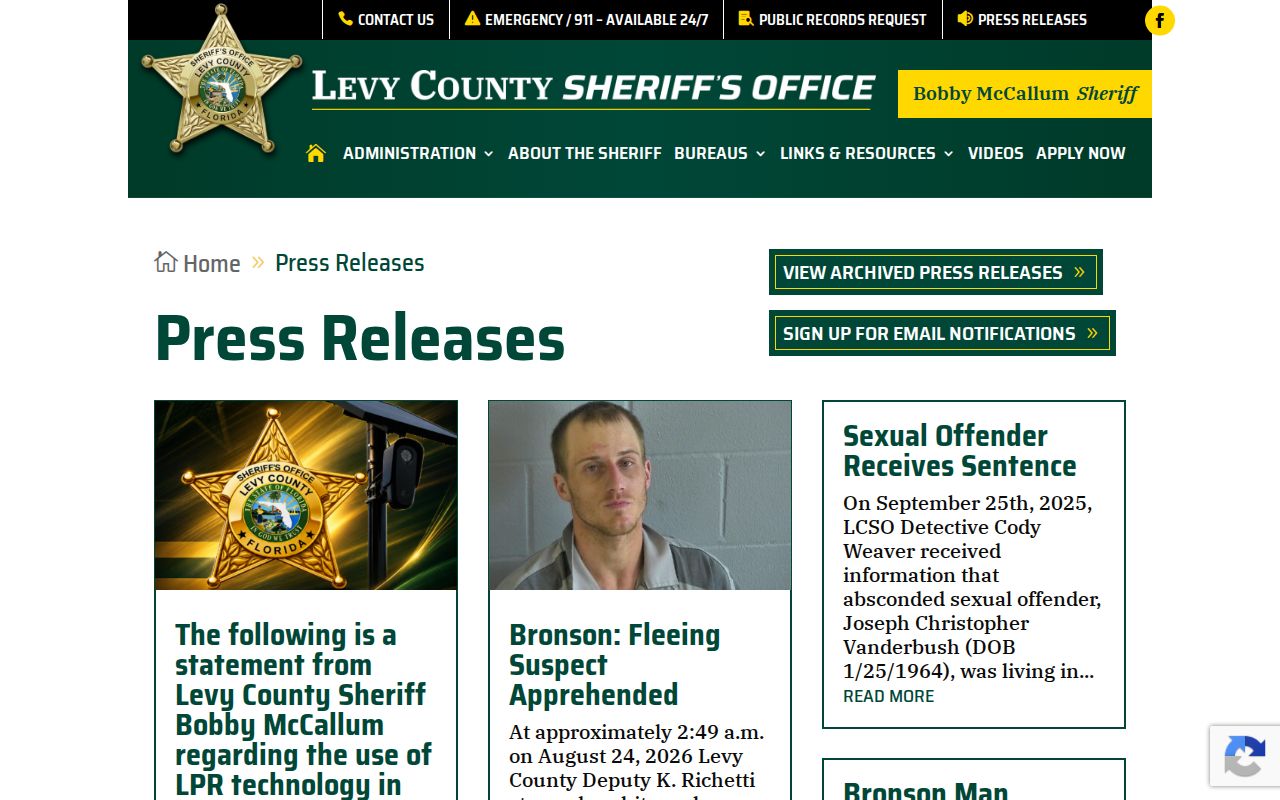
The archive adds context to selected Levy County events but stops short of a complete weekly booking list.
Build a Levy Multi-Day Log
Build the log backward from official records, not forward from a commercial index. That approach keeps custody status distinct from archived publication and helps sort out agency labels that cross city lines.
- Set the date range. Write down the first and last calendar dates needed. A “weekend” should have an explicit start and end.
- Search current custody. Open Levy Jail Tracker, use Current Only, and note the book date and booking number for relevant matches.
- Search releases. Use Released in Last 7 Days for a short blotter. Expand to 30 Days only when the period requires it.
- Open the detail. Compare cases, charges, holds, facility, and release information. Do not assume the arrest site from the facility name.
- Check agency publications. Review LCSO releases and local reports for selected narratives, keeping their publication date separate from the booking date.
- Request the record. For a complete date range or a record outside the interface, ask the Sheriff’s custodian for booking records or commitment and release lists.
A working log should carry the source and access date beside every row. Note each booking carefully. A news report and the Jail Tracker may disagree. The official custodian and court record control in that case. Never merge two similar names based on a photo or a city alone. The Levy County 24 Hour Arrests page handles the narrower same-day confirmation task.
Fields in Levy Arrest Records
Levy County publishes no official weekly report field set. Still, the roster and the Florida records schedule point to the core fields that matter for a multi-day arrest record. Keep one thing in mind. A requested commitment and release list can differ from what the public Jail Tracker displays.
| Field | How to read it in a blotter |
|---|---|
| Name | Use full name fields to separate similar people; confirm spelling with the source. |
| Book date | The jail intake date, not necessarily the publication date or exact arrest time. |
| Release date or method | Evidence of a recorded release event, not a statement about the court result. |
| Booking number | The best identifier for linking a roster row to a records request. |
| Arresting officer or agency | Identifies the law-enforcement source when the underlying record supplies it. |
| Charge and court | The charge as booked and the court connection; later filings can differ. |
| Bond | A release condition, never a measure of guilt. |
| Facility or jacket | Jail administration fields that do not by themselves show the arrest location. |
| Booking photograph | May display in a detail view or report, but public availability is conditional. |
The state schedule calls these records commitment and release lists. That term covers people booked into and released from a facility within a 24-hour period. A jail docket book is broader. It summarizes everyone incarcerated. These records can outlast an online roster entry. Retention never guarantees the same image link stays public.
How Levy Arrest Reports Get Republished
Arrest news in Levy County flows through a republishing pipeline rather than a single local feed. The Cedar Key News LCSO Arrest Report is one example. The outlet credits the Sheriff's Jail Media Report for its material. It copies photographs and commentary verbatim. So it works as a dated secondary copy, not a live jail roster or a Cedar Key-only arrest list.
HardisonInk's Levy County archive takes a different approach. It posts individual arrest, warrant, and sentence stories from across the tri-county area. Coverage there runs on events, not a set schedule. The 352today Crime & Safety section carries selected regional stories too. Those pieces often attribute facts to LCSO. Some use a stock or scene image instead of a booking photo. Neither outlet promises a complete Levy booking roster.
A few other outlets fill in the gaps. The Newscaster has offered weekly arrest compilations with dates attached. Florida & Cedar Key News keeps a Levy section, though without a dedicated current arrest blotter. Sources like these are useful for spotting a recent arrest event worth following. They fall short of proving who is in custody right now. For present custody status, the jail itself remains the place to check.
Unofficial Levy Archives Need Verification
Several commercial sites stretch Levy County arrest coverage past the official window. Their entries are not official records. RecentlyBooked Levy runs on a rolling last-30-days model and claims several refreshes per day. Counts and timestamps shift constantly. No fixed total belongs in a Levy County arrest log. Florida.Arrests.org Levy lists names, dates, cities, and charges. Bond amounts, booking photos, and agency filters appear too. Its year archive reaches into monthly records.
The agency filter deserves close attention. Arrests.org labels Levy results from LCSO, Chiefland Police, and Williston Police. The Florida Highway Patrol, probation, and neighboring agencies appear as well. A result does not prove LCSO made the arrest. It does not even prove the incident occurred in the listed city. Read the agency field, then verify with the source office.
Mugshots.com's Levy index leans toward older years, with no reliable daily cadence. Mugshots.zone Levy displays dynamic monthly archives. But it warns that information may be delayed or wrong. Neither can establish current custody. The expected BustedNewspaper Florida/Levy address returns a 404. A nearby route leads to Alabama, so it is not a valid Levy County source.
Official channels stay first. A commercial archive may preserve a stale arrest long after release, correction, sealing, or a favorable court result. It may also omit bookings entirely. Never treat its photo collection as a complete arrest log.
Levy Booking Archives and Retention
Florida sets the floor for how long booking paperwork must survive. The state's General Records Schedule GS2 spells out these minimums for law-enforcement series. Item 16 governs booking records. The rule is one anniversary year after release. Item 22 covers commitment and release lists on the same clock. Item 53 gives inmate incarceration records that same single year. Jail docket books get more time under Item 61: two anniversary years after the report.
Retention is one thing. Online display is another. A Levy arrest entry can vanish from Jail Tracker long before its retention period ends. The record itself may live on in a paper file, a backup, a court file, or another agency's storage. The Sheriff posts no Levy-specific policy on booking-photo retention or archive transfers. So ask the records custodian directly where a given series now sits.
Two tools help with Sheriff and detention records past the visible window. Use the records-request guidance or the NextRequest portal. Spell out the county, the agency, and the date range. Add the person's name, the booking number if you have it, and the exact series you want. Say whether you seek inspection or copies. If something is missing, ask whether it was destroyed under schedule, transferred, withheld, or held elsewhere. LCSO posts no booking-photo-specific fee and no guaranteed response time.
Old press coverage offers another route. The Florida Digital Newspaper Library holds Levy County Journal, Levy Citizen, Chiefland Citizen, and Williston Pioneer/Sun News material. It is a newspaper archive, not a custody database. Keep the issue date. When the outcome matters, get a certified disposition from the Levy County Clerk.
Note: A retained record and a live roster URL are two different questions, so never count on an old photo or link staying online.
Separate Arrest Date From Outcome
The official FDLE eligibility instructions show why an old arrest-log entry may need later legal context.
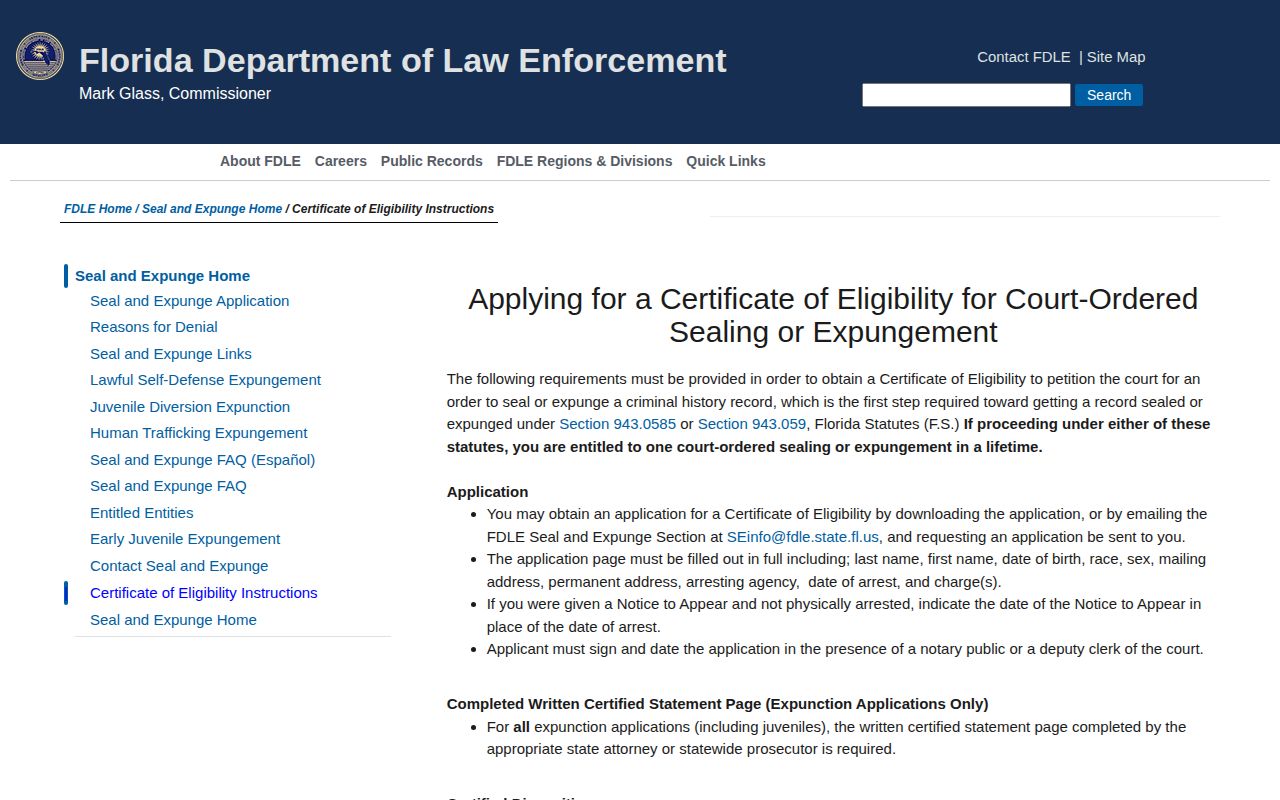
An arrest date and a court outcome are two different animals. FDLE eligibility rules and any later court order exist apart from the day an arrest first hit the log.
A multi-day log is really a chain of moments. The booking date marks intake at the jail. A release date shows the jail logged a release. A news date only tells you when a story ran. None of these dates reveals whether prosecutors filed the charge or how the court resolved it.
Conflict between sources calls for a simple tiebreaker. When an old article clashes with an official correction or a court disposition, trust the official record and the court result. Label every unofficial source clearly as you go.
The Levy County arrest-record guide maps the wider route, from the county roster to Sheriff records, the Clerk, and later custody systems. For multi-day work, the practice stays simple. Preserve dates and identifiers. Verify each claim at the office that owns the record.
Public Record Search
Sponsored Results